
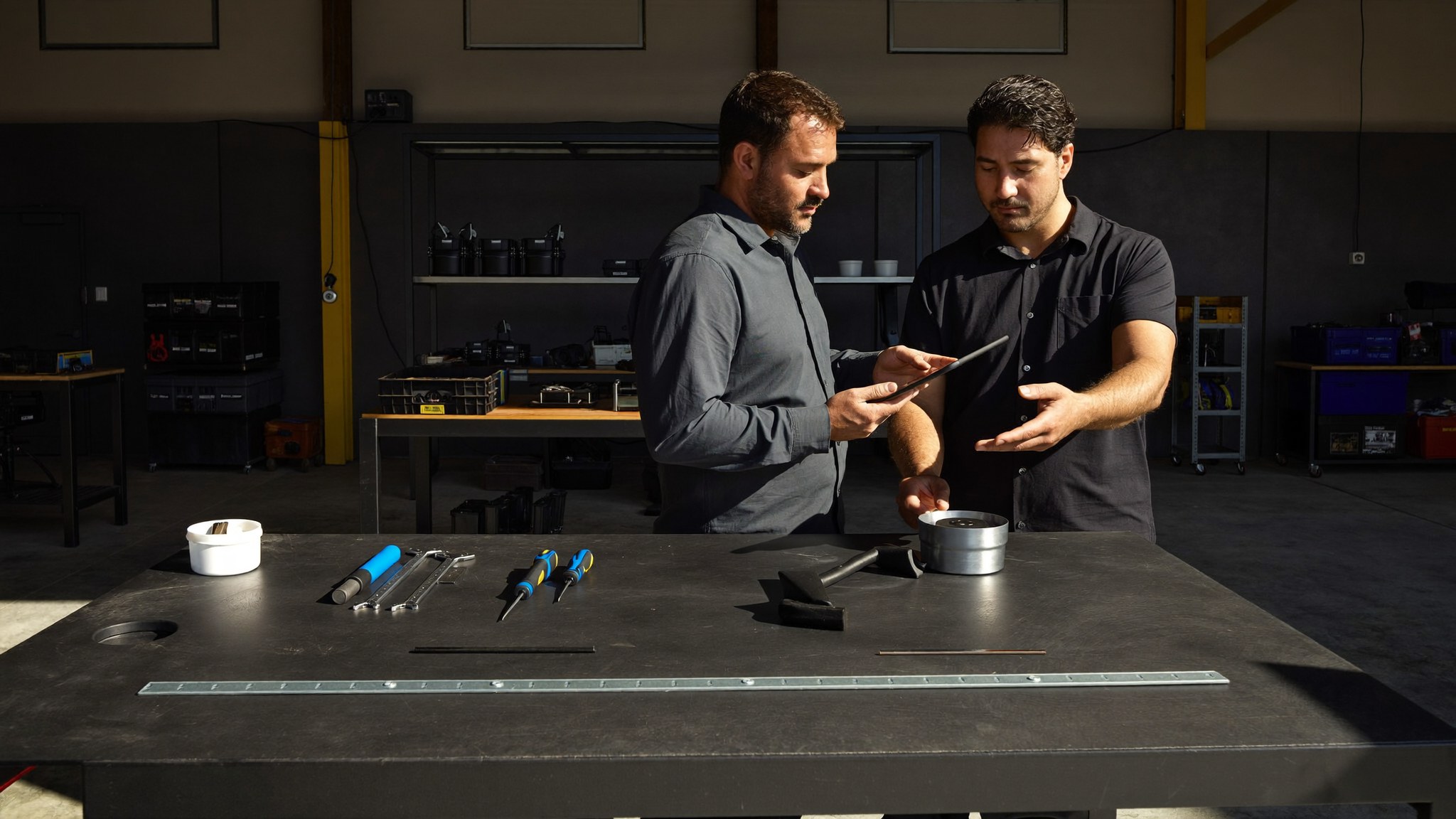
We don't sell services. We embed.
We believe technology only creates value when a person carries it into the work — and stays. CapEx exists to be that person: an operating partner that treats a business's goals as its own, and measures itself by whether the work actually gets better.
The four stages

01
EMBED
We sit inside your business, not across the table from it. A few days of watching how the work really happens tells us more than any questionnaire.
We spend time where the work happens — the calls, the invoices, the calendar, the parts of the week that eat your time — through observation, interviews, and a baseline of the numbers. This is the diagnostic: a fixed fee, roughly two weeks inside the business.

02
FIND
What actually moves your business — not what's fashionable to sell. Usually it's one or two things, and they're rarely the ones on the vendor's slide.
Once we understand the day, the bottlenecks are usually obvious: leads that go cold, quotes that take too long, paperwork that piles up on a Sunday. The diagnostic ends in a constraint map and one agreed priority — and if we stop there, the map is yours to keep.

03
BUILD
Exactly that, and nothing else. Website, ads, automation, software.
We start with how the business works today, preserve what is effective, and redesign what is creating friction. Each solution is a scoped project — a defined owner, timeline, and success criteria agreed before any work starts — and you can begin with a single, focused project. No packages, no add-ons you didn't ask for.

04
RUN
We stay. Things keep working, keep getting better, and you have a person to call — not a ticket.
Handing over a login isn't a result. Running is an operating partnership: adoption, training, monitoring, and steady improvement as the business changes — a fixed monthly management fee plus the actual spend (ads, software, usage) passed through at cost, our fee visible and no markup. We embed on-site wherever the business is. You own everything from day one — accounts, software, data, creative — and if we ever part ways, it all keeps working, and it is all yours.
We need a concept that evolves “bicycles for the mind” such that we always think of AI as a scaffolding for human potential vs a substitute.
Who we work best with
Fit was never about geography. What matters is where a business is, what it is ready for, and how its owner thinks.
Stage
An established, owner-led business — real customers, real revenue, and an owner still close to the work.
Readiness
Ready to change how the work gets done, not just buy another tool — and willing to let someone inside to do it.
Mindset
Honest about the numbers and the constraints, wanting a partner rather than a vendor, and measuring by results over activity.
Raleigh is home — where we were founded and where we proved the model. But home is who we are, not where we stop: the fit criteria decide who we work with, and geography decides nothing. When the right business is in Utah, or Istanbul, or Bogotá, we get on a plane.
Fractional Chief AI Officer
Someone who owns AI across the whole business — without a full-time executive hire.
Some businesses need more than a single build. They need a person accountable for how AI is used everywhere: what to adopt, in what order, with which tools, and under what rules. As a fractional Chief AI Officer, we take that seat part-time and work it from inside the business, the same way we work everything else. The measure is the same too: whether the work actually gets better.
Strategy and roadmap
AI tied to the goals the business already has, then sequenced into a roadmap in the order the team can actually absorb it.
Tools and vendors
Choosing what to use, and saying no to what isn't needed. Every recommendation is explained in plain terms, along with what it costs, before anything is bought.
Guardrails and people
Clear rules for data, privacy and how the team uses AI day to day, plus the training that makes it part of how people work rather than one more thing to learn.
It fits an established, owner-led business that wants AI owned by someone accountable before it is ready, or large enough, for a full-time hire.
AI, named plainly
When we say AI, we mean software that does real work: answering, sorting, following up, drafting, reminding. We'll always tell you what it does for your business in plain terms — and what it costs — before we build it.